Duvall & Hays, in their classic hermeneutics textbook Grasping God’s Word, elucidate the importance of being able to bridge the “river of difference” between two “towns” (culture, time, and worldview).
 The first town is the one where the author and his or her original audience lived — the generation that first received the text we are studying. The second is the town where we live — which is situated 2 or more millennia removed from that first town, and often in a very different culture (East vs. West). For some texts, that river of difference is very minor, and we can directly carry over the intended message from their town to our town without adjustment, e.g. the dietary code. We have the same anatomy they had, and we have the same G-d they had, so there is really no “river of difference” with regard to Leviticus 11 and Deuteronomy 14.
Other passages can be more difficult to bring across. Where the river of difference is vaster, we must extrapolate the “bridging principle” and navigate through idiomatic expressions and time-locked applications. One classic example is the command to build a fence around your roof. Is that necessarily applicable, in the p’shat reading*, to a 21st century American A-frame (peaked) roof? The command was given in a culture where roofs were flat and were used to host parties or dinners. If guests are imbibing in alcohol on that roof, not having a fence around it poses a danger of your guests falling off the roof and injuring themselves. So, the “bridging principle” here (remez reading) is that we are responsible to maintain our property in a way that eliminates risk of harm to others who might visit us. Perhaps we don’t entertain on our rooftops, but if there is a pool in our backyard, that is where we need to put the fence.
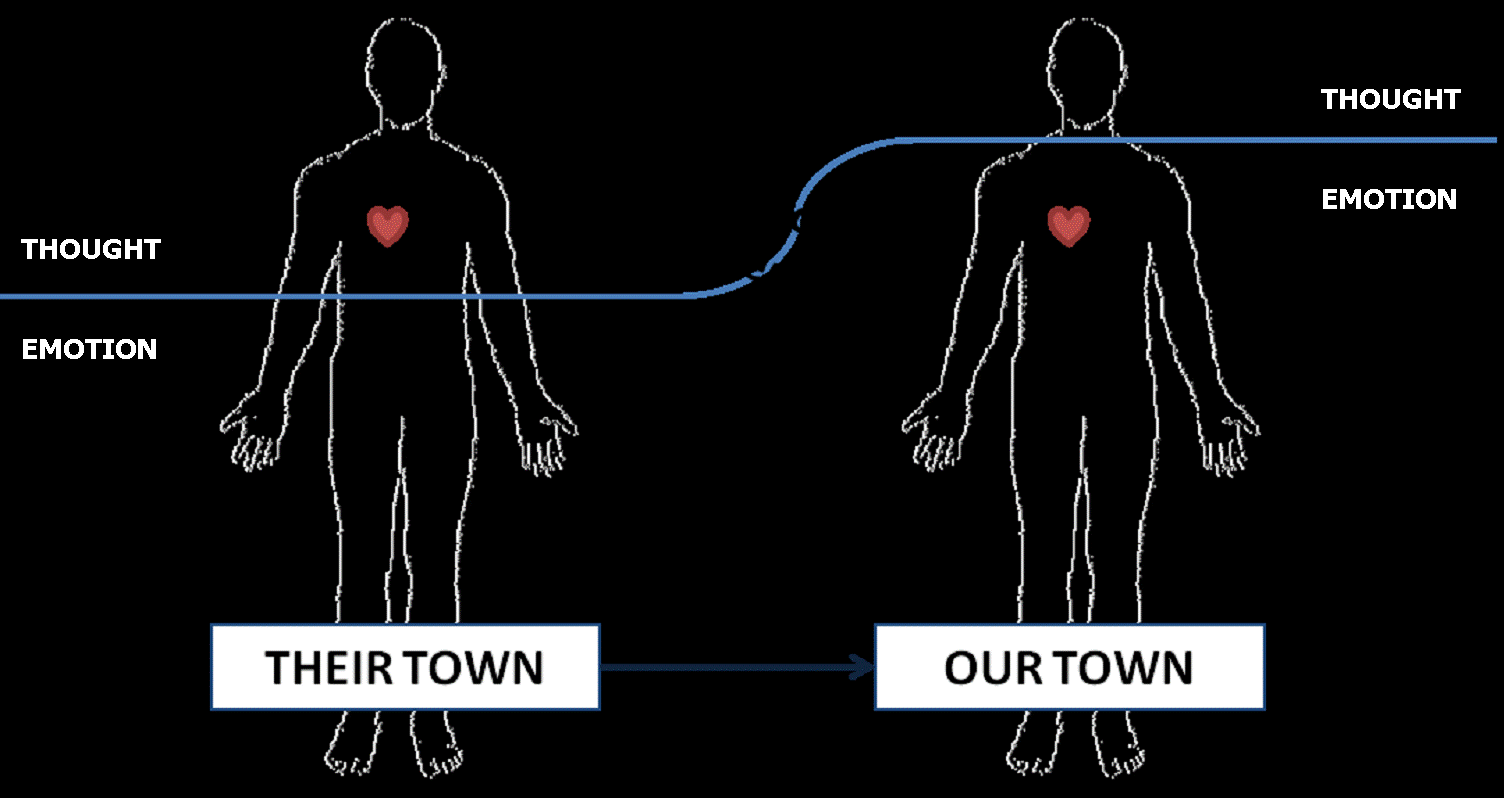
Given this background, we can now explore how the recognition of an idiom in the text might adjust our understanding. In the ancient world, the body was divided in half at the midpoint of the torso, and it was understood that anything above that midpoint was the seat of rational thought, while anything below it was the seat of emotion.
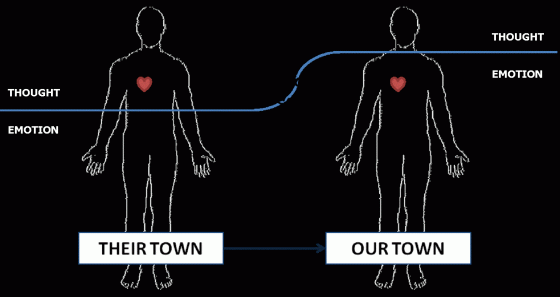
That means that the emotions of a person reside in and emanate from the “inmost parts” — the liver, the kidneys, the gut, or in KJV language, the bowels. The “heart” is not an emotional metaphor in “their town;” it is a metaphor for the seat of rational thought. So, when we are told that “a fools says in his heart, ‘There is no G-d'” (Psalm 14:1), we should understand that he has “reasoned” himself into atheism, not that an emotional defect needs to be overcome, but that we need to come together with this person and reason with him (Isaiah 1:18).
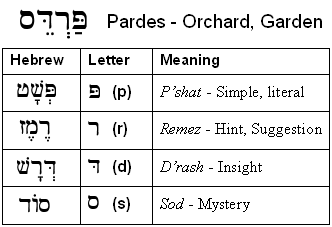 *In Jewish hermeneutics (Biblical interpretation), PaRDeS is not just a Persian loanword for “paradise,” it is a notarikon (acronym) for the interpretive process. P represents the p’shat (simple) reading — the plain meaning of the text. The p’shat meaning is the one least encumbered with “baggage” that comes eisogetically into the text through our theological presuppositions, and this meaning cannot be violated by any “deeper” meaning we might attach to the text (b. Shab. 63a; b. Yeb. 24a). The R of the notarikon stands for remez (hint) is the implied meaning of the text, not straightforwardly spelled out for us, but not difficult to discern from what is stated. The D (d’rash) is a little deeper, and would be akin to a commentary (midrash) on the passage, e.g. “this ancient concept is like this modern one.” Finally, the S level is the sod (hidden). In some camps, this is taken too far and used as an allowance to explore the text gnostically (kabbalistically), but the Talmudists did not have anything kabbalistic in mind (that cult did not exist until the 14th century); the sod is more the halakhic application of the text to our lives.
Continue reading →







 Yiddishkeit 101™